Professional Overview
"Welcome to my Professional Overview. In this section, I offer a reflective introduction that delves into my intellectual growth and professional development. I outline my research interests – digital equity in learning technologies, gamified learning in technical environments, instructional design for corporate settings, and AI's impact on access and learning for underrepresented groups – and professional goals, providing insight into the journey that has shaped my academic and professional pursuits. This overview connects the contents of my portfolio to my long-term objectives, helping to contextualize how my experiences and aspirations align with the goals of the program and my career ambitions."
Professional Overview
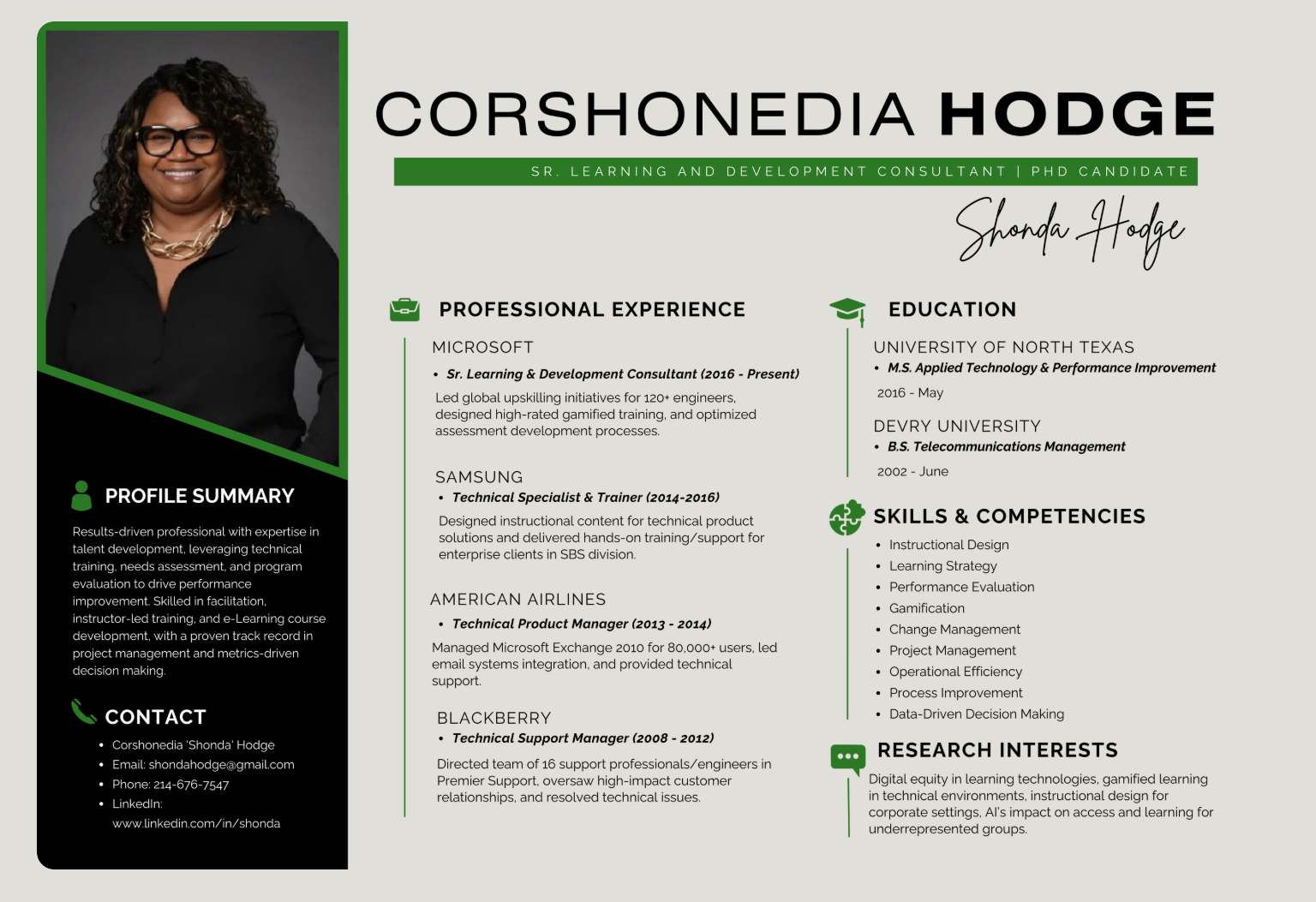
From an early age, my career aspirations shifted from law enforcement to medicine to music, but I ultimately found my calling in technology and education. After an initial detour in college, I attended a trade school where I discovered my passion for computers, eventually earning a bachelor’s degree in telecommunications management and beginning a career in IT. While working as a database administrator, I was asked to train colleagues on a conferencing system I had developed, which sparked a lasting interest in teaching and training. This passion led me to pursue a Master of Science in Applied Technology and Performance Improvement at the University of North Texas, where the mentorship of Dr. Rose Baker encouraged me to consider doctoral study, even though I initially resisted the idea.
My career path eventually brought me to Microsoft, where I transitioned from engineering into official training roles. I was recognized for my contributions with internal awards and conference opportunities, and in 2021 I became a Learning and Development consultant, responsible for training support engineers in professional skills. Throughout this time, Dr. Baker continued to inspire me to pursue research and advanced study, and with her encouragement—along with the support of my family, colleagues, and mentors—I applied to the PhD program at UNT. Since entering the program in 2023, I have navigated the challenges of imposter syndrome and grown through the support of my cohort, faculty, and community.
Intellectual Growth and Research Interests
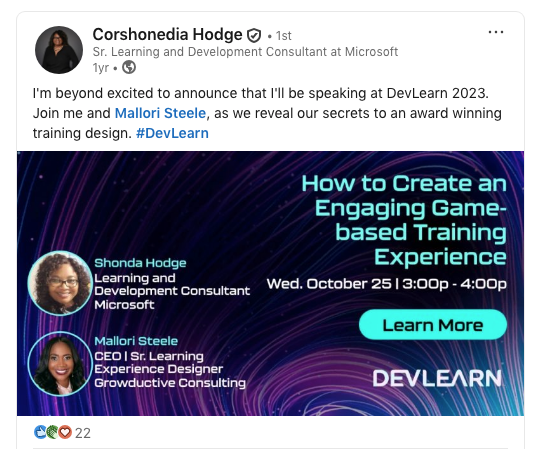
My doctoral journey has been characterized by intellectual curiosity, professional transformation, and a deep commitment to advancing equity through technology and learning. Early in the program, I earned an industry certification in gamification that was the impetus for my first conference presentation opportunity. I presented my gamified training design at the 2023 TechLearn Conference, where it earned Best Use of Narrative and was featured in the September TechLearn Magazine. Later that year, I facilitated a session at DevLearn 2023 on designing game-based learning experiences. These early experiences expanded my professional network and marked my transition from corporate training to academic scholarship.
My coursework provided a foundation for research and scholarly writing. Under Dr. Norris’s guidance, I authored Unraveling Digital Disparities: Examining Historical Consequences of Limited Internet Infrastructure Investment in African American Communities Post-Pandemic. This formative experience taught me how to conduct a literature review and structure an academic argument. Encouraged by Drs. Norris and Edyburn, I began exploring the multifaceted nature of the digital divide—particularly how historical inequities and systemic disinvestment shape access to emerging technologies. Through Dr. Cockerham’s class, I strengthened my writing skills; Drs. Lee and Warren further developed my quantitative and qualitative analytical capabilities.
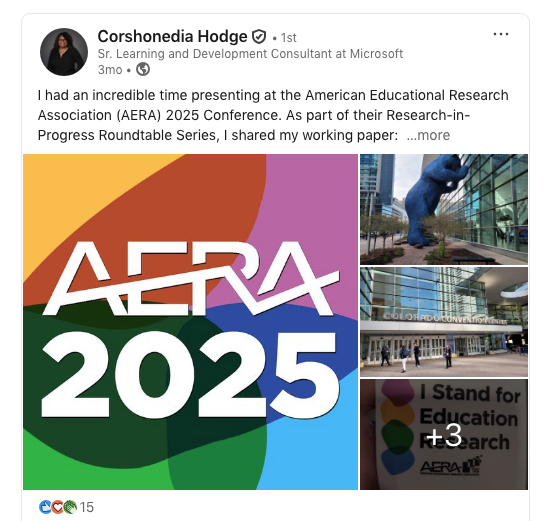
The summer of 2024 marked a pivotal milestone in my development as a researcher. Under Dr. Baker’s mentorship, I co-authored Bridging or Widening: The Impact of Artificial Intelligence on the Digital Divide Among Black Americans, structured as a PRISMA-based literature review written for journal submission. That experience deepened my methodological rigor and writing proficiency. Our collaborative team presented this work at the ISPI-EMEA Conference, solidifying my confidence as a researcher-practitioner. Building on that momentum, I submitted proposals to three major conferences--SITE 2025, AERA 2025, and CALICO 2025. All three were accepted; however, due to financial constraints, I presented at two of them: SITE 2025 and AERA 2025.
Further research opportunities continued to refine my focus. In Dr. Knezek’s course, I collaborated on a national survey examining African Americans’ attitudes toward AI and the digital divide, leading to a poster presentation at EdMedia 2025 in Barcelona. My most challenging and rewarding milestone came in my 6800 seminar, where I independently authored Digital Capital in Redlined Communities: Does Race Shape Access to Opportunity in the Age of AI?—a culmination of my research trajectory to date. Guided by Drs. Baker and Edyburn, I applied spatial analysis and GIS mapping to visualize digital inequities across historically redlined neighborhoods. This work represents the synthesis of my evolving interests in digital capital, equity, and AI-driven transformation.
Today, my research centers on the intersection of digital equity, AI, and social geography. Specifically, I examine how historical patterns of redlining and infrastructural neglect continue to influence digital inclusion. My long-term goal is to produce evidence-based research that will hopefully inform policy and practice at local, state, and federal levels—bridging the gap between technological advancement and equitable access.
Professional Goals
My professional goals are grounded in bridging academic research and corporate practice to drive the future of learning and workforce development in the era of artificial intelligence. As a Senior Learning & Development Consultant at Microsoft and a PhD candidate in Learning Technologies, I operate at the intersection of innovation, leadership, and inclusion—where scholarly inquiry directly informs strategic impact.
In the corporate context, I aim to focus on large-scale learning transformation, digital adoption, and ethical AI integration. I aspire to guide organizations in designing learning ecosystems that are data-driven, inclusive, and aligned with the evolving demands of the future workforce. My work is motivated by the belief that corporate learning can serve as both an engine of innovation and a lever for social equity.
Beyond my corporate leadership experience, I aspire to contribute to higher education by translating real-world industry insights into academic learning environments. Drawing on my experience in corporate learning and development, I aim to help university students bridge the gap between theory and practice—showing how the concepts they study in the classroom directly apply to workplace contexts. By integrating practical case studies, technology-driven learning design, and workforce readiness principles, I can help students understand how learning translates into impact across professional settings.
My goal is to equip students with the skills and mindsets necessary to thrive in an evolving, technology-rich world. Through teaching, I also hope to demonstrate how building partnerships between universities, corporations, and communities can expand digital access and opportunity, particularly for underserved populations. This collaborative approach not only enhances student learning but also supports broader efforts to reduce the digital divide and create more inclusive pathways to success.
Ultimately, my professional vision is to serve as a bridge between research and practice—helping organizations anticipate future skill needs, adopt AI responsibly, and contribute to inclusive innovation ecosystems.

-
![]()
American Educational Research Association (AERA) 2025 Conference
-
![]()
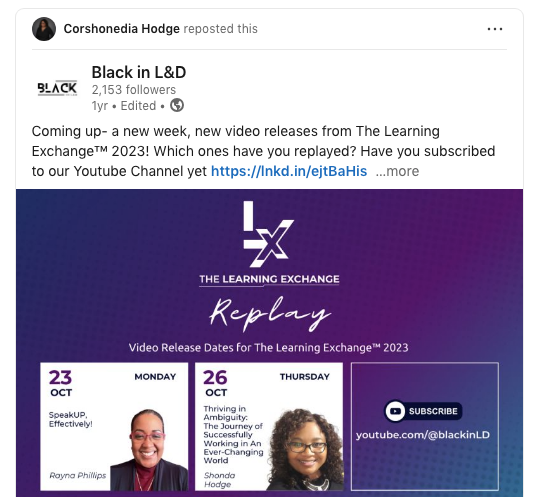
Black in L& D - The Learning Exchange™ "Thriving in Ambiguity: The Journey of Successfully Working in An Ever-Changing World" by Corshonedia Hodge
-
![]()
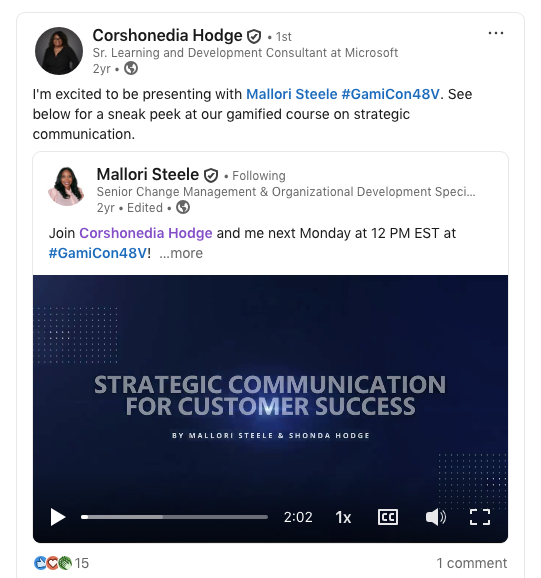
Gamification Project - Journey to Sovershenstvo: Strategic Communication for Customer Success
-
![]()
DevLearn Conference 2023 'How to Create an Engaging Game-Based Training Experience' by Corshonedia Hodge
-
![]()
Corshonedia Hodge, Sr. Learning & Development Consultant @ Microsoft
-
![]()
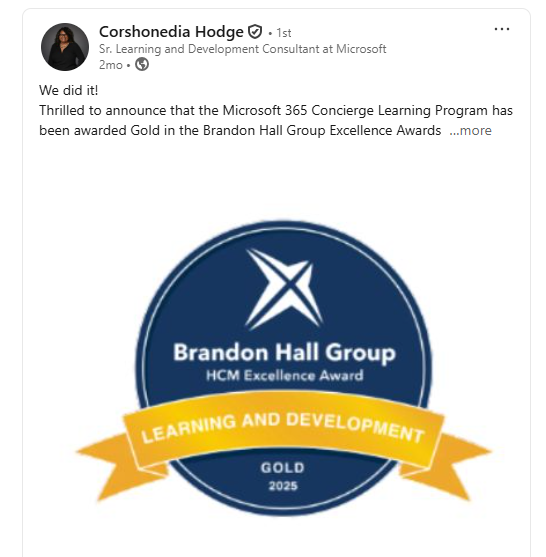
Brandon Hall Group Learning & Development - Gold 2025